
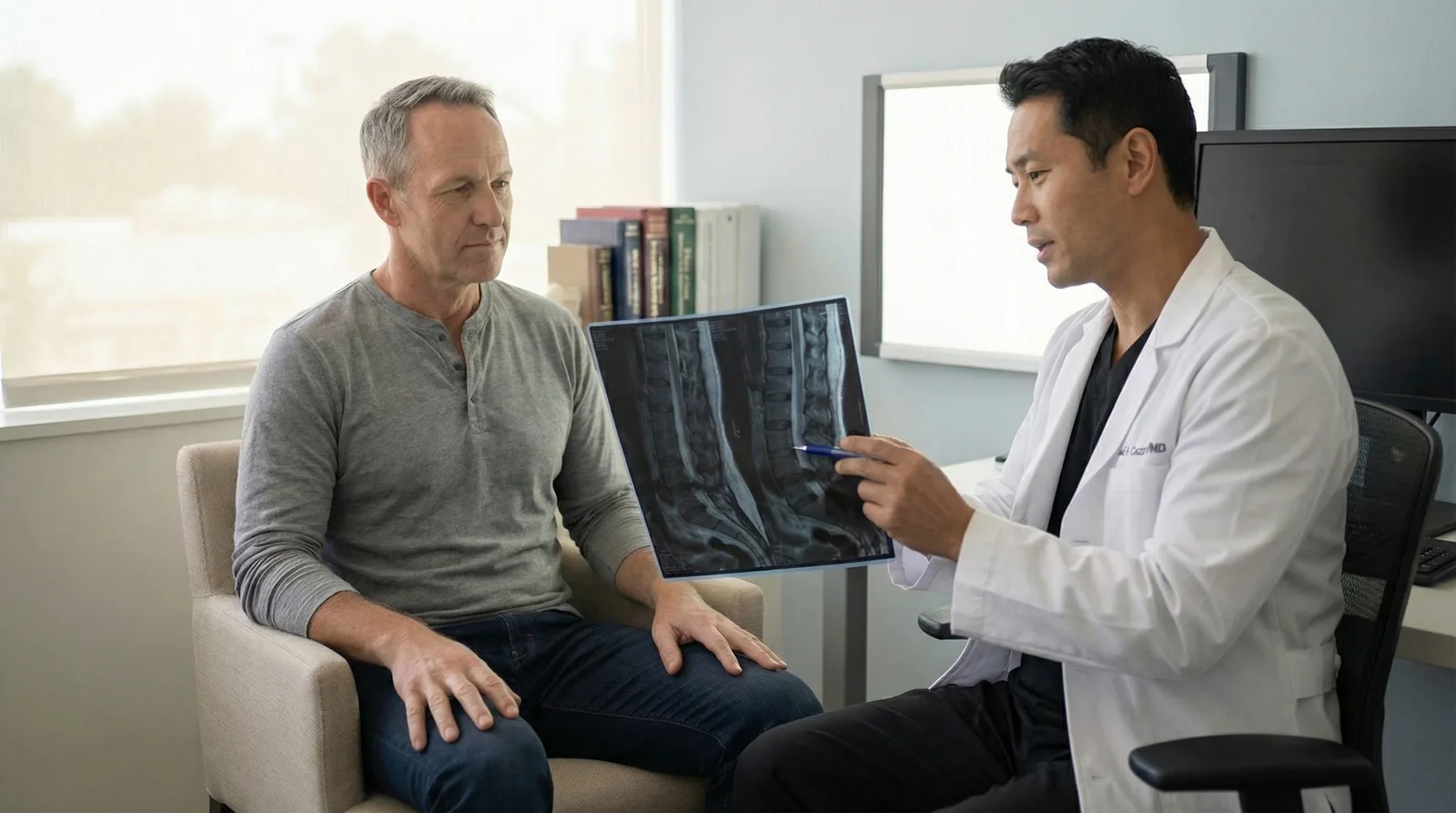
SPINE-SPECIFIC REHABILITATION
The Only Conservative Treatment That Removes the Load
Physical therapy strengthens the muscles around the spine. Chiropractic adjusts alignment. Injections manage pain signals. But none of them reduce the mechanical load on a damaged disc.
Spinal decompression is the only conservative, non-surgical approach that directly reduces intradiscal pressure — creating an environment where damaged tissue can begin to heal.
That's what makes this rehabilitation, not just treatment.
SPINE-SPECIFIC REHABILITATION
The Only Conservative Treatment That Removes the Load
No other conservative treatment directly reduces the mechanical load on a damaged disc.
That's what makes this rehabilitation, not just treatment.
The Problem
Your Spine Never Gets a Break
Even when you're sitting still, your discs are under load. Standing, sitting, bending — every position compresses the spine. A damaged disc never gets the unloaded environment it needs to heal because you can't stop using your spine.
Disc pressure during daily activities
Sitting, slouched forward
Upright standingbaseline
Lifting 20 kg, bent back
Source: Nachemson 1966
Think of it like a fracture that never gets a cast. The injury exists, but the area is never immobilized long enough for repair to begin. That's the mechanical reality of a damaged disc — constant load, no recovery window.
The Mechanical Gap
Other Treatments Help — But They Can't Unload the Disc
Physical therapy, chiropractic, stretching, and even traction all have a role in spine care. But none of them achieve what spinal decompression does mechanically: reducing intradiscal pressure below baseline — into negative pressure territory.
Conventional traction pulls on the spine, but the body resists. Muscles guard against the force, and intradiscal pressure actually increases rather than decreasing. Computerized decompression solves this with real-time feedback that works with the body's neuromuscular response — not against it.
Traction vs. decompression
Upright standingbaseline
Conventional horizontal traction
Computerized spinal decompression
Source: Nachemson 1966; Anderson et al. 1983; Ramos & Martin 1994
In the only published in vivo measurement study, motorized spinal decompression was observed to reduce intradiscal pressure below zero — a finding not reported with conventional traction, inversion, or other conservative approaches (Ramos & Martin, J Neurosurg, 1994). That's the mechanical foundation that makes structured rehabilitation possible.
Intradiscal Pressure Across Positions & Interventions
Measured and estimated values from peer-reviewed research
Lying down
Standing & sitting
Loading & lifting
Traction & inversion
In the only published in vivo measurement study, motorized spinal decompression was observed to reduce intradiscal pressure below zero.
This finding has not been reported with conventional traction, inversion, or other conservative approaches. The equipment and protocol determine whether true decompression occurs. — Ramos & Martin, J Neurosurg, 1994
Sources
Nachemson A (1966). The load on lumbar disks in different positions of the body. Clin Orthop Relat Res 45:107–122.
Wilke HJ et al. (1999). New in vivo measurements of pressures in the intervertebral disc in daily life. Spine 24(8):755–762.
Ramos G, Martin W (1994). Effects of vertebral axial decompression on intradiscal pressure. J Neurosurg 81:350–353.
Anderson GB et al. (1983). Intradiscal pressure during traction. Spine 8(2):146–154.
The Guarding Cycle
Why Pain Makes Everything Worse
Chronic spinal pain triggers a protective response: muscles around the injured area tighten and guard to limit movement. This guarding increases compression on the disc, which increases pain, which increases guarding. It's a self-reinforcing cycle that restricts mobility and prevents healing.
Computerized decompression systems are designed to work around this guarding response. By using controlled, sub-threshold force with real-time micro-adjustments, the system gradually reduces spinal loading without triggering the very muscle response that maintains the problem.
Over a course of sessions, this allows the guarding cycle to break down — restoring range of motion, reducing protective tension, and creating the conditions for functional improvement.
Progressive Treatment
Why Session 1 Isn't Full Intensity
Spinal decompression follows the same principle as any structured rehabilitation: progressive loading. Early sessions use lower settings to allow the body to acclimate — reducing guarding, establishing tolerance, and identifying how your spine responds.
As treatment progresses, parameters are adjusted based on your response. This is why a single introductory session — or a few scattered visits — doesn't represent what this therapy actually does. Those are acclimation-level settings, not therapeutic ones.
A complete course of care is structured like any rehabilitation program: graduated, progressive, and designed to build toward maximum functional improvement over time.
Treatment Progression
Lower settings, establishing tolerance, reducing initial guarding response
Parameters increase as body acclimates, therapeutic levels reached
Optimized settings based on individual response, maximum therapeutic benefit
What Improvement Looks Like
Function, Not Just Pain Reduction
Pain improvement matters. But it's not the only thing that changes. Patients in structured decompression programs typically report improvements across multiple functional dimensions:
Mobility
Increased range of motion and tolerance to movement that was previously painful or restricted
Daily Function
Ability to sit, stand, walk, and perform daily activities with less limitation and less avoidance
Sleep Quality
Reduced nighttime pain and improved ability to find comfortable positions for restful sleep
Activity Tolerance
Gradual return to exercise, work activities, and physical engagement that pain had limited
You can debate what negative pressure does inside the disc. What you can't debate is that it's the only conservative treatment that achieves it — and that the functional outcomes in patients who complete a full course of care are consistently favorable.

Treatment vs. Rehabilitation
A single session is treatment. A structured, progressive course of care designed to restore function is rehabilitation.
A Single Treatment
- Reduces symptoms temporarily
- Acclimation-level settings only
- No progressive protocol
- No functional improvement measured
- Often used as a sales demo
Structured Rehabilitation
- Progressive protocol over multiple sessions
- Parameters adjusted to individual response
- Muscle guarding cycle addressed systematically
- Functional improvement tracked and measured
- Continues to Maximum Therapeutic Improvement
Related Pages


Find a Preferred Provider
Enter your zip code to see if a credentialed provider is available near you.
Why choose a preferred provider?Ready to Find Out If You're a Candidate?
Take our quick 3-minute assessment to see if spinal decompression may be appropriate for your situation. It's free, confidential, and takes just a few questions.
Take the AssessmentGet Started
We've got your info!
We don't have a preferred provider in your area just yet, but we'll reach out as soon as one becomes available.