

Decompression Translated
What Most Clinics Won't Tell You
The term "spinal decompression" is everywhere. But what's actually being delivered behind that label varies so dramatically that most patients never receive the therapy the way it was designed to work.
Decompression Translated
What Most Clinics Won't Tell You
The term "spinal decompression" is everywhere. But what's actually being delivered varies so dramatically that most patients never receive the therapy the way it was designed to work.
The Term "Spinal Decompression" Doesn't Mean What You Think
Online influencers use the term to describe a certain type of stretch. Some practitioners use it to describe basic traction. There's no regulation around the term "spinal decompression" — anyone can use it.
A clinic can buy a basic traction table for a few thousand dollars, call it decompression, and charge you the same price as a provider using nearly $100,000 in sophisticated equipment with the latest computer-guided software, real-time patient monitoring, and biofeedback.
In fact, basic traction can actually increase disc pressure — the opposite of what treatment should do.
So when a patient says "I tried decompression and it didn't work," the honest question is: did you actually receive it? In many cases, the answer is no.
See how real spinal decompression worksSide by Side
What You Get — and What You Don't
| Any Clinic | Preferred Provider | |
|---|---|---|
| Equipment verified? | You'd have to ask — and you wouldn't know what to look for | Verified before they join the platform |
| Treatment protocol | Varies — may not follow one at all | Structured, matches published clinical patterns |
| How many sessions? | "We'll see how it goes" | Defined treatment course with clear endpoint |
| Total cost | You'll find out as you go | One flat price, known before treatment starts |
| Treatment coverage | Per-session billing or fixed packages — if you need more, you buy another package | Unlimited treatments until Maximum Therapeutic Improvement (MTI) |
| What if it takes longer? | You keep paying | You're already covered — no additional charges |
| Candidacy screening | "Let's get you started" | Evaluated before treatment begins — not everyone qualifies |
| Who vetted them? | No one | Equipment, protocol, and pricing independently verified |
Equipment verified?
You'd have to ask — and you wouldn't know what to look for
Verified before they join the platform
Treatment protocol
Varies — may not follow one at all
Structured, matches published clinical patterns
How many sessions?
"We'll see how it goes"
Defined treatment course with clear endpoint
Total cost
You'll find out as you go
One flat price, known before treatment starts
Treatment coverage
Per-session billing or fixed packages — if you need more, you buy another package
Unlimited treatments until Maximum Therapeutic Improvement (MTI)
What if it takes longer?
You keep paying
You're already covered — no additional charges
Candidacy screening
"Let's get you started"
Evaluated before treatment begins — not everyone qualifies
Who vetted them?
No one
Equipment, protocol, and pricing independently verified
"If all these clinics offer the same thing, why would it matter where I go?"
Because they don't offer the same thing. They use the same word. The equipment, the protocol, the training, and the pricing model behind that word are completely different — and you have no way to tell from the outside.
The Knowledge Gap
You Don't Know What Questions to Ask
It's not your job to know this stuff. But the problem is, most of this information isn't easy to find online — and every clinic will tell you they offer spinal decompression. None of them will tell you they're underqualified.
"What's the difference between the equipment?"
Most patients don't know there's a difference between a traction table and a true decompression system — they're both called the same thing. And most wouldn't know whether the equipment being used has any clinical research behind it.
See how this is solved ↓"How often should I go, and for how long?"
A proper treatment plan depends on the severity of your condition and how your body responds. Some patients improve in just a few sessions. Others need 12 or more. Without a structured protocol, there's no honest way to answer this — and many clinics don't have one.
See how this is solved ↓"How do I know if it's working?"
Pain relief doesn't always come first. A qualified provider will track objective markers — like leg strength and muscle function — that show your body is responding before the pain fully resolves. Without that evaluation, you're guessing.
See how this is solved ↓"What's the total cost?"
Because everyone responds to treatment differently, clinics that bill per session or sell fixed packages often can't give you a straight answer. If you need more sessions than the package covers, you buy another one. The cost becomes unpredictable.
See how this is solved ↓
What We've Already Done for You
A Preferred Provider Has Already Been Vetted
We've already asked the questions you can't. We've verified the equipment. We've confirmed the protocol. We've required pricing transparency. All you have to do is show up for your evaluation.
Equipment verified — research-grade systems, not rebranded traction tables
Protocol confirmed — structured treatment plans matching published clinical patterns
Pricing locked — Total Relief Care Plan™ with no surprise billing
Candidacy screening required — no one gets pushed into treatment they don't need
The Financial Side
You Shouldn't Have to Worry About Being Overbilled
One of the biggest frustrations patients face isn't the cost — it's the uncertainty. How many sessions will I need? What if it takes longer? Am I going to keep getting charged every week with no end in sight?
Preferred providers use the Total Relief Care Plan™ — a single, clearly defined investment that covers your full corrective treatment course. If your treatment takes 20 sessions or 30, the cost doesn't change. No upselling. No session-by-session billing.
Compare that to what most clinics offer: per-session pricing with no defined endpoint, package deals sold before you've been evaluated, or ongoing "maintenance" plans that never end. With a preferred provider, the financial picture is clear before treatment begins.
The Bottom Line
We've Done the Work So You Don't Have To
You shouldn't have to become an expert in decompression equipment to avoid getting the wrong treatment. You shouldn't have to interrogate your provider about their protocol. You shouldn't have to guess what your total cost will be.
That's what this platform does. We've already evaluated the equipment, confirmed the protocol, and required financial transparency — so when you walk into a preferred provider's office, the only thing you need to focus on is whether this therapy is right for your specific condition.
Find a Preferred Provider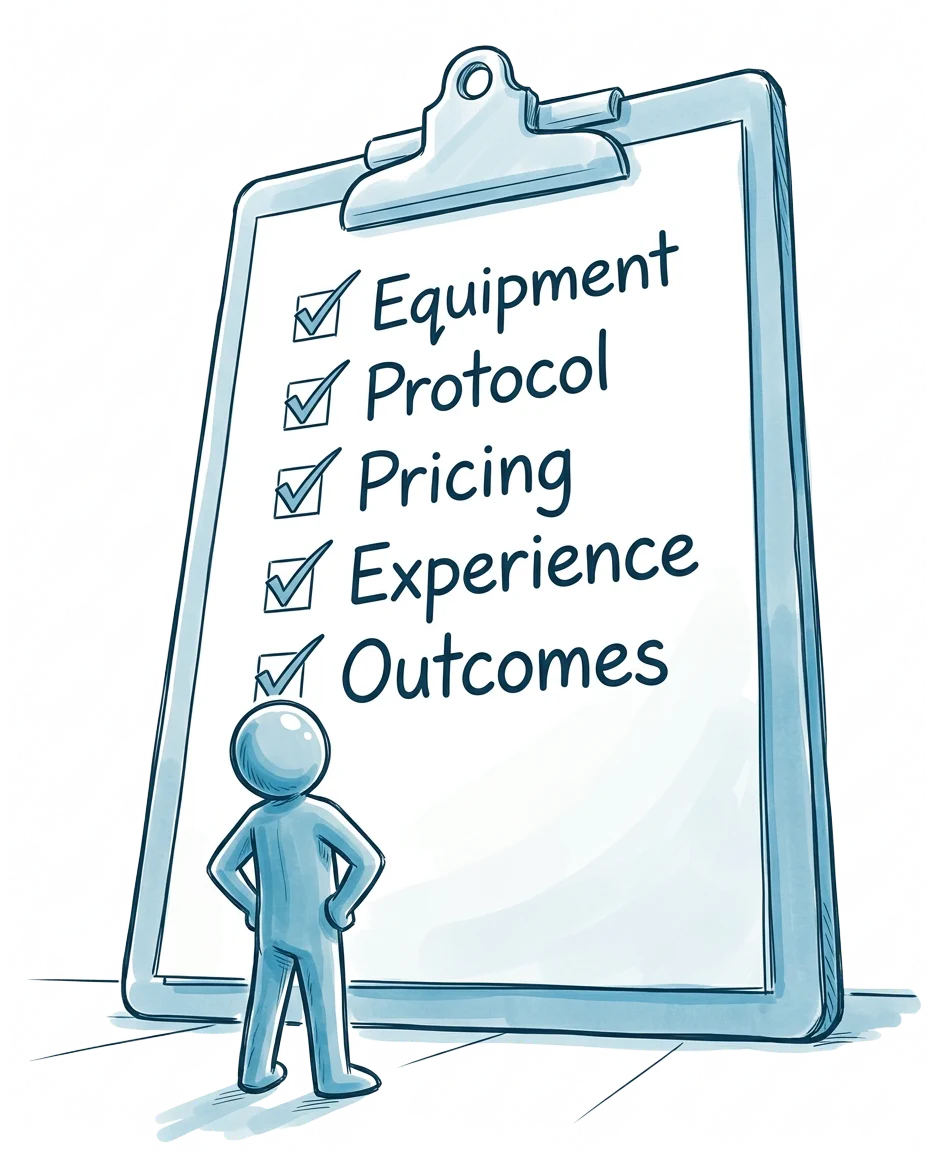
Going somewhere else isn't necessarily a bad choice. But it's an uninformed one — because without verification, you have no way to know if what you're receiving is what was actually shown to work.
For qualified candidates, the biggest predictor of outcome isn't necessarily the severity of the condition — it's whether the provider used proper equipment and followed a structured protocol. That's why standardization matters.



Find a Preferred Provider
Enter your zip code to see if a credentialed provider is available near you.
Why choose a preferred provider?Ready to Find Out If You're a Candidate?
Take our quick 3-minute assessment to see if spinal decompression may be appropriate for your situation. It's free, confidential, and takes just a few questions.
Take the AssessmentGet Started
We've got your info!
We don't have a preferred provider in your area just yet, but we'll reach out as soon as one becomes available.