
Spinal Decompression for Herniated Discs
A herniated disc is one of the most common reasons patients explore spine-specific rehabilitation through spinal decompression — and one of the conditions where the therapy's mechanism has the most direct relationship to the problem.
 Herniated discs are among the most studied indications for spinal decompression. Candidacy still depends on your specific presentation.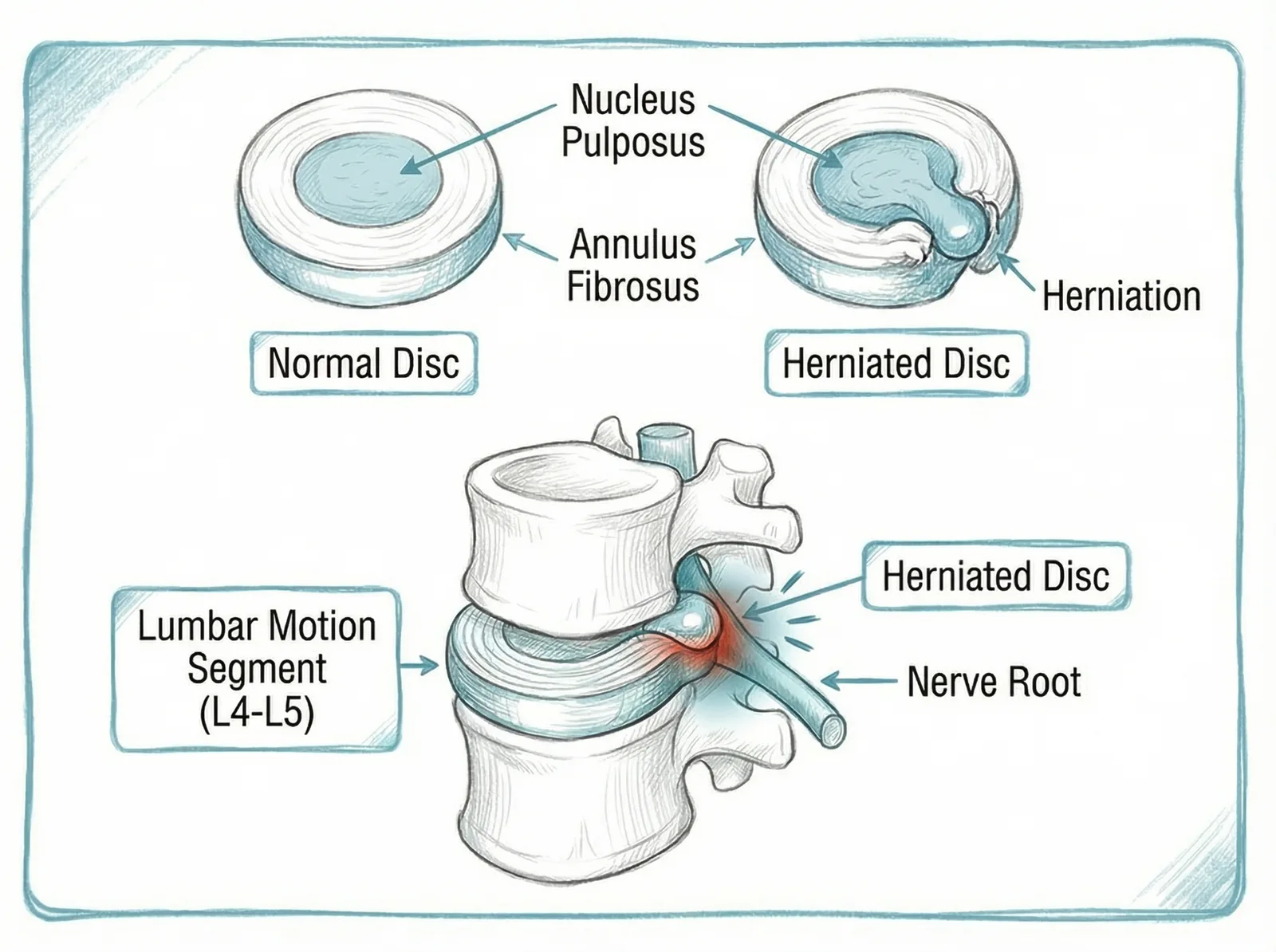
Understanding Your Condition
What Is a Herniated Disc?
A herniated disc occurs when the soft inner material of a spinal disc pushes through a tear in the outer layer. This displaced material can compress nearby nerves, producing pain, numbness, tingling, or weakness — often radiating into the arms or legs depending on the location.
It's one of the most common causes of sciatica and radicular pain, and one of the primary conditions that spinal decompression was designed to address.
The Problem & the Approach
How Decompression Addresses a Herniated Disc
Spinal decompression doesn't push a disc back into place — that's an oversimplification you'll see on other sites. Here's what it's actually designed to do.

The Problem
Compression & Displacement
The herniated material creates mechanical pressure on nerves and surrounding structures. Sustained loading prevents the disc environment from recovering.

What Decompression Does
Controlled Unloading
Computer-guided protocols reduce load on the affected segment, altering intradiscal pressure and reducing disc pressure to support healing.

The Goal
Functional Recovery
Improved mobility, reduced nerve irritation, and better tolerance to daily activities — supported by the body's own capacity for adaptation.
Reducing Load on the Affected Segment
Targeted, computer-controlled forces unload the specific spinal level where the herniation has occurred. The system monitors your body's response in real time — adjusting for muscle guarding, reflexive tension, and neuromuscular resistance.
Altering the Disc's Mechanical Environment
Reduced compression changes intradiscal pressure gradients, supporting fluid exchange and nutrient diffusion. This supports the disc's biological response — not a mechanical "pushing back" of disc material.
Reducing Nerve Irritation Over Time
As the mechanical environment changes, nerve tolerance may improve. Patients often report gradual reduction in radiating symptoms — the pain, numbness, and tingling that characterize disc-related nerve compression.
How to think about this realistically
Decompression won't mechanically push disc material back into place or correct the herniation directly — but it alters the mechanical environment in ways that support the body's own healing capacity. Research shows that many disc herniations naturally regress over time, and decompression supports that process.
“"The patients who do best with decompression are the ones whose providers take the time to confirm the diagnosis matches the therapy. When the indication is right and the equipment is proper, the outcomes speak for themselves."
Setting Expectations
What Patients with Herniated Discs Typically Experience
These are observed patterns — not guarantees. Individual responses depend on severity, duration, and compliance with the treatment protocol.
Radiating Symptoms Often Improve First
Many herniated disc patients report that leg or arm symptoms — the shooting pain, numbness, or tingling — begin improving before localized back or neck pain resolves.
Gradual, Not Instant
Improvement develops over a structured course of treatment. Most patients complete care within 20–30 visits. Early sessions establish the mechanical change; later sessions build on it.
Functional Gains Lead Pain Reduction
Patients often notice they can sit longer, stand without shifting, or sleep through the night before their pain score drops on a scale.
Some Patients Experience Significant Relief
Herniated disc patients are among those who most commonly report meaningful improvement. But individual variation still applies — no treatment works identically for every patient.
About early aggravation
Some patients — particularly those with long-standing herniations — experience temporary symptom increases during the first few sessions. This reflects the nervous system adapting to a change in the mechanical environment, not the herniation worsening. Patients who continue through this phase typically see it resolve.
What Research Shows About Disc Herniations
Systematic reviews consistently show that many lumbar disc herniations naturally regress over time. The body has a documented capacity to reabsorb herniated disc material — a process observed in clinical imaging studies.
Conservative care — including spinal decompression — is widely endorsed as a first-line approach. Guidelines across multiple medical disciplines support exhausting conservative options before considering surgery for most disc herniations.
Candidacy
Are You a Candidate?
Not all herniated disc patients are candidates — but this is one of the conditions where candidacy is most commonly confirmed. The key factors are whether your symptoms correlate with imaging findings and whether any contraindications exist.
Favorable Indicators
- MRI-confirmed herniation correlating with symptoms
- Radiating pain, numbness, or tingling consistent with nerve involvement
- Incomplete relief from PT, injections, or medications
- Committed to completing a full course of care
- Seeking a non-surgical alternative
- Realistic expectations about outcomes
Contraindications & Limitations
- —Cauda equina syndrome (surgical emergency)
- —Spinal fractures, tumors, or infections
- —Severe osteoporosis
- —Pregnancy
- —Hardware or fusion at the treatment level
- —Severe spinal instability
Evaluation confirms what a website can only suggest. Your imaging, symptoms, history, and physical presentation all factor into the candidacy determination. A qualified provider assesses the full picture.
Common Questions About Herniated Discs & Decompression
Specific answers for patients with disc herniations.

Can decompression actually fix a herniated disc?
It doesn't "push it back in." It alters the mechanical environment in ways that may support the body's natural capacity to heal. Many herniations regress on their own — decompression may support that.
Read More →
Is this safe with a herniated disc?
When properly screened, yes. The therapy is non-invasive with no injections or incisions. Equipment monitors your response in real time and adjusts accordingly.
Read More →
Should I try this before considering surgery?
Clinical guidelines widely support exhausting conservative options before surgery for most disc herniations. Decompression is one of those conservative options.
Read More →Related Pages


Find a Preferred Provider
Enter your zip code to see if a credentialed provider is available near you.
Why choose a preferred provider?Ready to Find Out If You're a Candidate?
Take our quick 3-minute assessment to see if spinal decompression may be appropriate for your situation. It's free, confidential, and takes just a few questions.
Take the AssessmentGet Started
We've got your info!
We don't have a preferred provider in your area just yet, but we'll reach out as soon as one becomes available.