
Degenerative Disc Disease and Spinal Decompression: What's Realistic
If you've been told your discs are degenerating, you've probably been given the impression that things are falling apart. The reality is more nuanced — and so is how decompression relates to this condition.
 Spinal decompression does not reverse disc degeneration. Treatment relevance depends on whether your degeneration is causing symptoms that correlate with mechanical disc issues.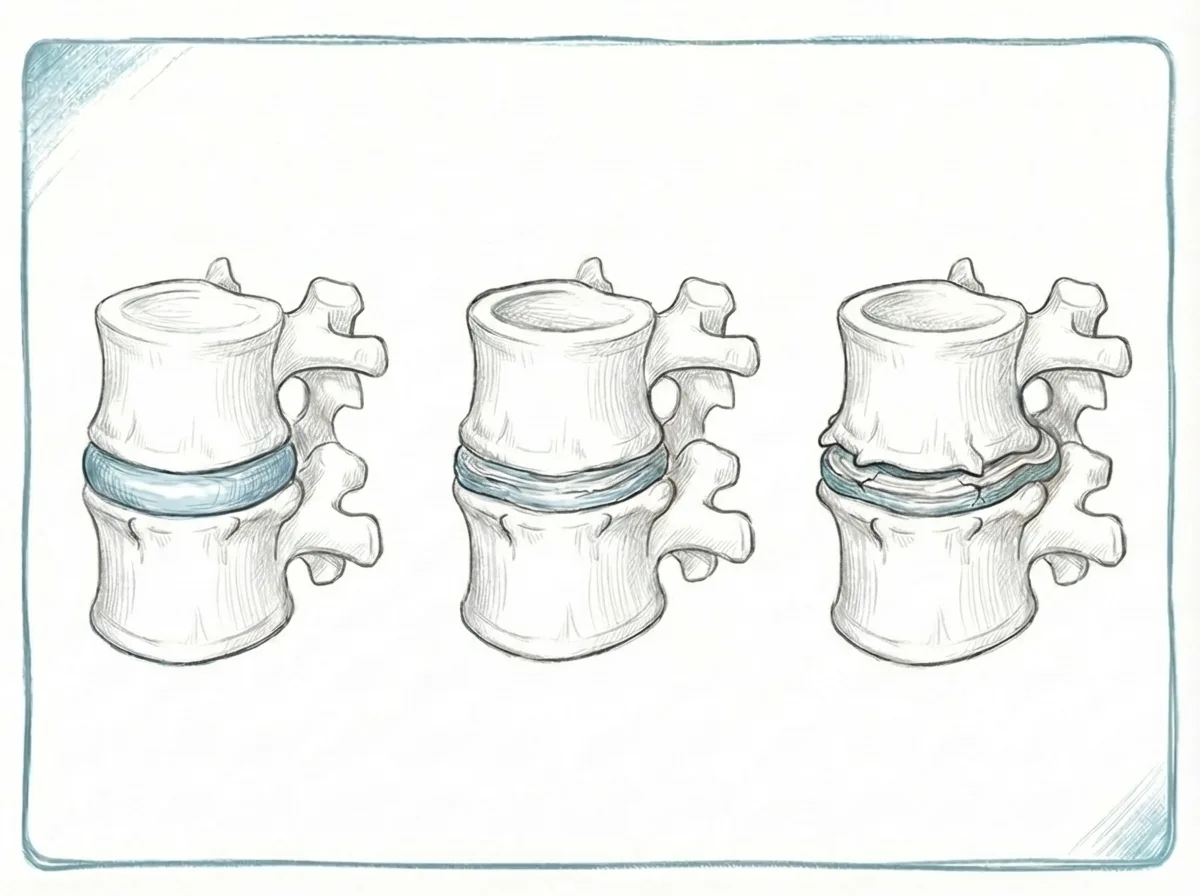
Understanding Your Condition
What Is Degenerative Disc Disease?
First, an important reframe: “degenerative disc disease” is not actually a disease. It's a term describing age-related changes in spinal discs — loss of hydration, reduced disc height, and changes to the disc's structural integrity over time.
These changes are extremely common. Imaging studies show significant disc degeneration in a large percentage of people who have no symptoms at all. Having degeneration on an MRI doesn't automatically mean you need treatment — it depends on whether the degeneration is causing symptoms that impact your function and quality of life.

What's Realistic
How Decompression May Help — and What It Won't Do
The relationship between decompression and DDD is real but limited. Understanding both sides prevents unrealistic expectations.
Reducing Load on Degenerative Segments
Degenerative discs distribute load differently than healthy discs. This altered mechanics can produce pain and nerve irritation. While decompression won't restore lost disc height or reverse structural degeneration, controlled unloading may reduce the symptomatic effect of this altered load distribution.
Supporting Whatever Disc Capacity Remains
Even degenerative discs retain some biological activity. Reduced compression supports fluid exchange and nutrient diffusion within the remaining disc tissue — modest support for the disc's residual function, not a restoration.
Improving Functional Tolerance
Patients with symptomatic DDD often experience improved sitting tolerance, walking endurance, and activity capacity during treatment. These functional gains — not structural reversal — are the realistic outcome measure.
““In my experience, the biggest predictor of outcome isn't the severity of the condition — it's whether the provider used proper equipment and followed a structured protocol. That's why standardization matters.”
Setting Expectations
What DDD Patients Typically Experience
Expectations for DDD patients must be calibrated differently than for herniation or bulge patients. Functional improvement — not structural correction — is the realistic measure.
Functional Improvement Is the Goal
Patients most commonly report improvements in daily activities — sitting longer, moving more easily, sleeping better. These are the meaningful outcomes for DDD, where structural reversal isn't on the table.
Symptom Management, Not Cure
DDD is a chronic condition. Treatment may significantly reduce symptoms and improve quality of life, but the underlying degeneration remains. Setting this expectation early prevents disappointment later.
Response Varies More Widely
Because DDD varies enormously in severity, location, and symptom correlation, patient responses are more variable than with herniations. Some patients respond well. Others modestly. This wider variation is expected.
Corrective Care Has a Defined Endpoint
Like all conditions, the corrective phase has a defined completion — typically 20–30 visits. What happens after depends on the chronic nature of your condition.
About Maintenance Care for DDD
Because DDD is a chronic, progressive condition, some patients benefit from periodic maintenance sessions after completing corrective care. This is different from “needing to come forever” — it's analogous to ongoing exercise for a chronic condition.
Maintenance care is always optional, offered separately from the corrective phase, and recommended only when clinically appropriate. It does not imply that corrective treatment failed.
About early aggravation
Degenerative discs can be more sensitive to changes in their mechanical environment. Some patients experience temporary symptom increases during early treatment. Providers monitor this closely and adjust protocols accordingly.
Candidacy
Is Decompression Right for Your DDD?
Not all DDD warrants treatment of any kind. Having degeneration on imaging — even significant degeneration — doesn't mean you need decompression. The question is whether the degeneration is producing symptoms that impact your life and that correlate with what decompression targets.
Candidacy for DDD patients requires realistic expectations from the start. If a patient expects structural reversal or a permanent cure, a responsible provider will correct that expectation before beginning treatment — not after.
General contraindications include:
Imaging plus symptom correlation determines candidacy. Degeneration on MRI alone is not sufficient. Your symptoms must correlate with the affected levels, and your expectations must align with what the therapy can realistically deliver.
Common Questions About DDD & Decompression
Honest answers about what decompression can and cannot do for degeneration.

Can decompression reverse my disc degeneration?
No. No conservative treatment reverses degeneration. Decompression may improve the environment around degenerative discs and support functional improvement, but the structural changes remain.
Read More →
Will I need maintenance care forever?
Not necessarily. Some DDD patients benefit from periodic sessions; others maintain gains through exercise and activity alone. Maintenance is optional and separate from corrective care.
Read More →
My doctor said DDD is just normal aging. Should I ignore it?
If you're not having symptoms, possibly. But if degeneration is causing real pain and functional limitations, “normal” doesn't mean “acceptable.” The question is whether it's impacting your life.
Read More →Related Pages


Find a Preferred Provider
Enter your zip code to see if a credentialed provider is available near you.
Why choose a preferred provider?Ready to Find Out If You're a Candidate?
Take our quick 3-minute assessment to see if spinal decompression may be appropriate for your situation. It's free, confidential, and takes just a few questions.
Take the AssessmentGet Started
We've got your info!
We don't have a preferred provider in your area just yet, but we'll reach out as soon as one becomes available.