
Spinal Decompression for Bulging Discs
A bulging disc is one of the most common findings on MRI — but not all bulges cause symptoms, and imaging alone doesn't determine whether treatment is needed. Here's how to think about it clearly.
 A bulging disc on imaging doesn't automatically mean you need treatment. Symptoms, not images alone, determine whether intervention is appropriate.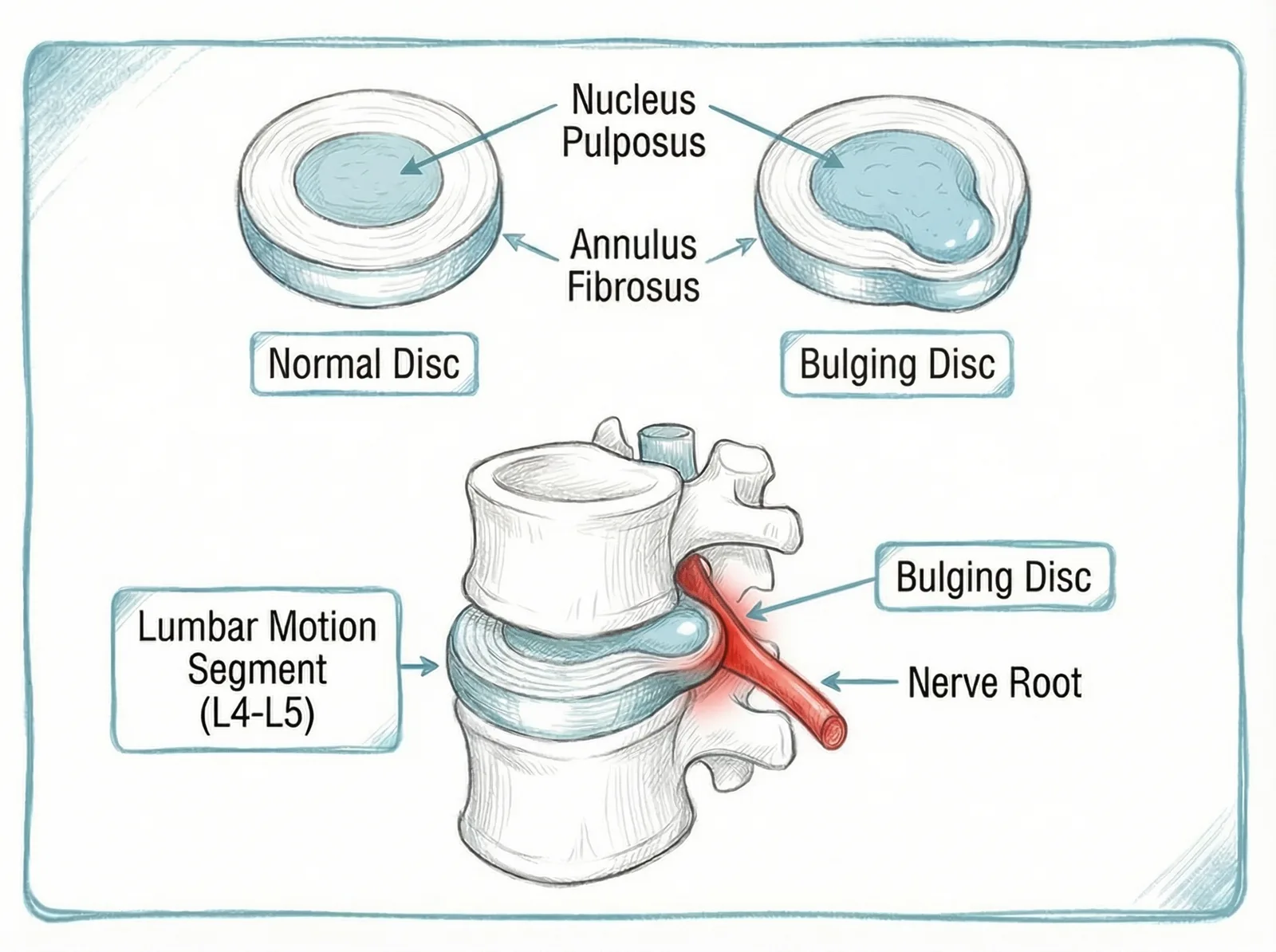
Understanding Your Condition
What Is a Bulging Disc?
A bulging disc occurs when the disc extends beyond its normal boundaries — but unlike a herniation, the outer layer remains intact. Think of it as a tire that's slightly over-inflated and pushing out evenly, rather than a tire with a puncture.
Bulging discs are extremely common — many people have them on MRI without any symptoms at all. They become clinically relevant when the bulge compresses nerves or alters spinal mechanics enough to produce pain, numbness, tingling, or functional limitations.
Critical Distinction
Not Every Bulging Disc Needs Treatment
This is something many clinics won't tell you — and it's one of the reasons honest evaluation matters more than imaging alone.
Imaging alone doesn't determine whether you need decompression
Studies consistently show that a large percentage of people with no back pain at all have bulging discs visible on MRI. A bulge that appears on imaging but doesn't correlate with your symptoms is likely an incidental finding — not a reason for treatment.
What matters is whether the bulge is compressing a nerve or altering spinal mechanics in a way that produces your specific symptoms. This correlation — between what the image shows and what you experience — is what evaluation determines.
How Decompression Addresses a Symptomatic Bulge

The Problem
Compression & Load
A symptomatic bulge creates pressure on nearby nerves or spinal structures. Sustained loading prevents the disc environment from recovering.

What Decompression Does
Controlled Unloading
Precise, computer-guided forces reduce load on the affected segment, altering intradiscal pressure and reducing disc pressure to support healing.

The Goal
Functional Recovery
Improved mobility, reduced nerve irritation, and better daily function — supported by the body's own healing capacity.
Reducing Load on the Affected Segment
Targeted forces unload the specific spinal level where the symptomatic bulge has been identified. Real-time monitoring adjusts for muscle guarding and neuromuscular resistance.
Supporting Disc Health
Reduced compression supports fluid exchange and nutrient diffusion within the disc — processes that are impaired when a disc is under sustained load. This creates conditions for the body's biological response, not a mechanical "pushing back."
Improving Nerve Tolerance
As the mechanical environment changes around the bulging segment, nerve irritation decreases. Patients often report gradual reduction in radiating symptoms as treatment progresses.
“"The patients who do best with decompression are the ones whose providers take the time to confirm the diagnosis matches the therapy. When the indication is right and the equipment is proper, the outcomes speak for themselves."
Setting Expectations
What Patients with Bulging Discs Typically Experience
Observed patterns from clinical practice. Individual responses depend on whether the bulge is truly symptomatic, its severity, and compliance with the treatment protocol.
Symptom Patterns Similar to Herniations
Patients with symptomatic bulges often experience improvement patterns similar to herniation patients — radiating symptoms tend to improve before localized pain, and functional gains often precede pain-score changes.
Gradual Improvement Over a Course of Care
Changes develop over 20–30 visits. Early sessions establish the mechanical change; later sessions build on it. This is rehabilitative, not a quick fix.
Daily Function Often Improves Meaningfully
Sitting tolerance, sleep quality, ability to exercise or work without aggravation — these are the functional markers that patients most commonly report improving.
Results Depend on Accurate Correlation
Patients whose symptoms clearly correlate with the bulge on imaging tend to respond better than those where the correlation is unclear. This is why evaluation — not just imaging — determines candidacy.
About early aggravation
As with herniations, some patients experience temporary symptom increases during early sessions. This is a normal part of the adaptive process and typically resolves as treatment progresses.
What About Bulges That Don't Cause Symptoms?
If a bulging disc was found on imaging but you're not experiencing symptoms that correlate with it, treatment may not be necessary. Many bulges are age-related findings — common, normal, and not inherently dangerous.
A responsible provider will assess whether your symptoms actually match the imaging findings before recommending treatment. If they don't match, they should tell you — not sell you into care you don't need.
Candidacy
Are You a Candidate?
Candidacy for bulging disc treatment hinges on one critical question: is the bulge actually causing your symptoms? Imaging confirmation plus symptom correlation is the standard — not imaging alone.
Favorable Indicators
- MRI-confirmed bulge with symptoms that correlate to the affected level
- Pain, numbness, or tingling consistent with nerve involvement
- Incomplete relief from other conservative approaches
- Functional limitations that impact daily life
- Commitment to completing a full course of care
Contraindications & Limitations
- —Bulge on imaging without correlating symptoms (incidental finding)
- —Spinal fractures, tumors, or infections
- —Severe osteoporosis or spinal instability
- —Pregnancy
- —Hardware or fusion at the treatment level
Evaluation determines whether imaging findings match your symptoms. A qualified provider assesses the full picture — not just the MRI. If the bulge isn't causing your pain, they should tell you.
Common Questions About Bulging Discs & Decompression
Specific answers for patients with disc bulges.

What's the difference between a bulge and a herniation?
A bulge extends evenly with the outer layer intact. A herniation involves material pushing through a tear. Both can cause symptoms and both may respond to decompression.
Read More →
My MRI shows a bulge but my doctor said it's normal. Do I need treatment?
Possibly not. Many bulges are age-related and asymptomatic. Treatment is only appropriate when the bulge is actually causing symptoms. If it's not — a good provider will tell you.
Read More →
Can a bulging disc get worse without treatment?
Some bulges remain stable indefinitely. Others may progress. The factors that influence this — loading patterns, activity, overall disc health — are part of what evaluation assesses.
Read More →Related Pages


Find a Preferred Provider
Enter your zip code to see if a credentialed provider is available near you.
Why choose a preferred provider?Ready to Find Out If You're a Candidate?
Take our quick 3-minute assessment to see if spinal decompression may be appropriate for your situation. It's free, confidential, and takes just a few questions.
Take the AssessmentGet Started
We've got your info!
We don't have a preferred provider in your area just yet, but we'll reach out as soon as one becomes available.