
Sciatica and Spinal Decompression
Sciatica describes a symptom pattern — pain radiating along the sciatic nerve — not a diagnosis. What's compressing the nerve determines whether spinal decompression is a rational approach or not.
 Sciatica is a symptom pattern, not a diagnosis. The cause of the nerve irritation — not the symptom itself — determines whether decompression applies.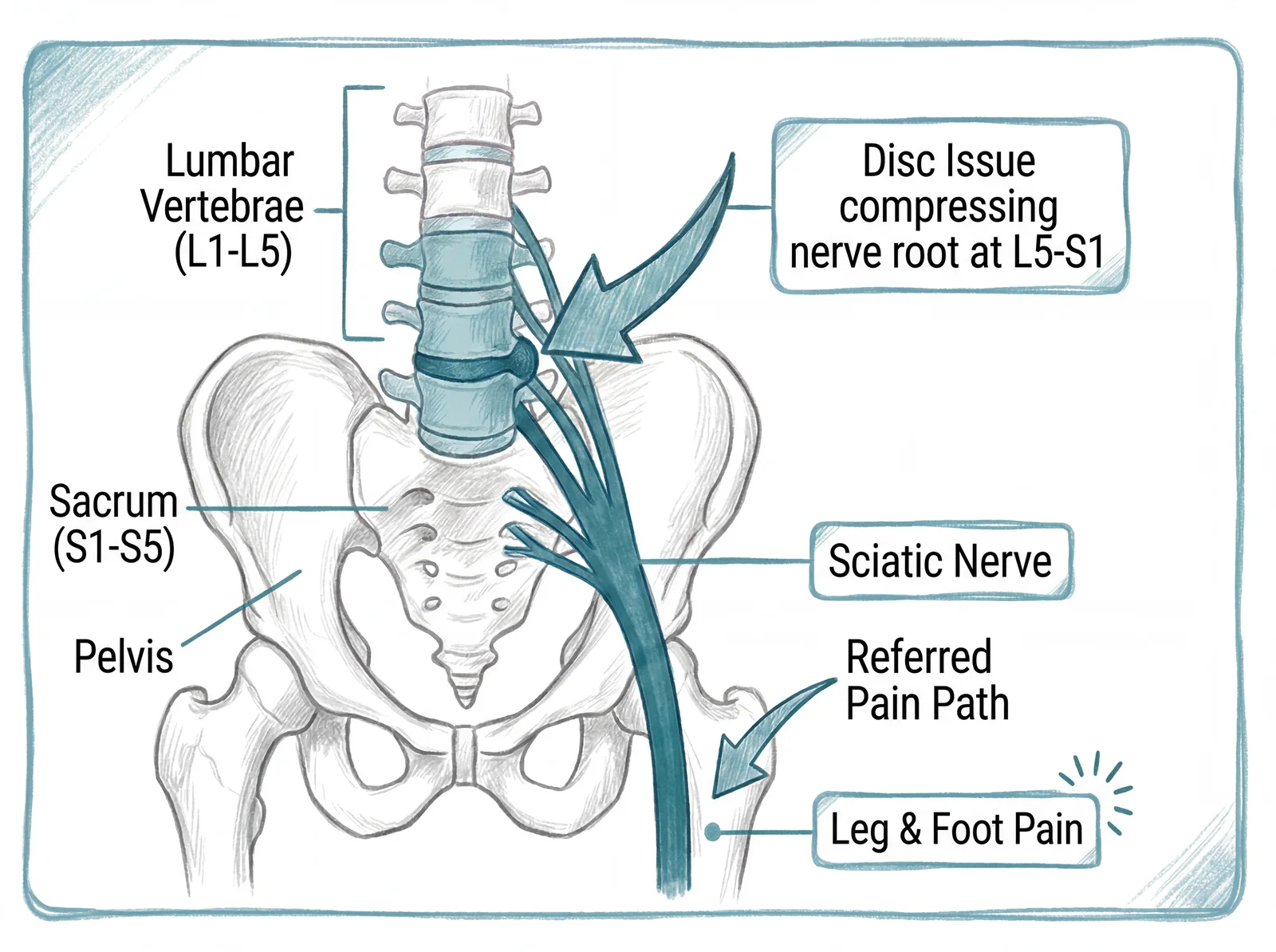
Understanding Your Symptoms
What Is Sciatica, Really?
If you've been told you have “sciatica,” you've been given a description of your symptoms — not an explanation of why you have them. Sciatica means pain, numbness, tingling, or weakness that follows the sciatic nerve from the lower back through the hip and down the leg.
The critical question isn't whether you have sciatica. It's what's irritating the nerve. That answer determines the right treatment approach — including whether spinal decompression has any role to play.
Sciatica from Disc Compression
- Herniated or bulging disc confirmed on MRI compressing a nerve root
- Symptoms that follow a dermatomal pattern consistent with the affected level
- Pain that worsens with sitting, bending, or loading the spine
- Incomplete relief from PT, medications, or epidural injections
Sciatica from Non-Disc Sources
- —Piriformis syndrome — the piriformis muscle compresses the nerve in the hip
- —Sacroiliac joint dysfunction referring pain along the sciatic pathway
- —Spinal stenosis causing neurogenic claudication (more on that condition page)
- —Hip pathology mimicking sciatic nerve symptoms
Know the underlying cause? Explore the specific condition:
When the Cause Is Disc-Related
How Decompression May Help Disc-Related Sciatica
When sciatica is caused by a disc herniation or bulge compressing a nerve root, the rationale for decompression is straightforward — it targets the mechanical source of the nerve irritation.
Unloading the Compressed Segment
Computer-guided protocols reduce load specifically at the spinal level where the disc is compressing the nerve root. Real-time monitoring adjusts for your body's muscle guarding response — the reflex that can otherwise prevent effective unloading.
Changing the Nerve's Mechanical Environment
By altering intradiscal pressure and reducing direct compression on the nerve root, the therapy improves nerve tolerance. The nerve doesn't need to be “freed” — it needs the pressure around it to change enough for irritation to resolve.
Supporting the Body's Healing Response
Research shows many disc herniations naturally regress over time. Decompression supports this process by altering the loading environment — reducing disc pressure to support healing.
If the cause isn't disc-related, decompression won't address it
This is the honest reality that separates responsible providers from those who treat every sciatic patient the same way. Piriformis syndrome needs soft tissue work. SI dysfunction needs joint-specific treatment. Stenosis may or may not respond depending on the type. Decompression is not a universal sciatica treatment — it's a disc-specific intervention.
““In my experience, the biggest predictor of outcome isn't the severity of the condition — it's whether the provider used proper equipment and followed a structured protocol. That's why standardization matters.”
Setting Expectations
What Sciatica Patients Typically Experience
These patterns apply specifically to patients whose sciatica is disc-related. If the cause is different, the treatment response will be different.
Leg Symptoms Often Improve Before Back Pain
The radiating component — the shooting pain, numbness, or tingling down the leg — frequently begins improving before any localized back pain resolves. This pattern is common and often encouraging to patients who've been suffering.
Symptoms May “Centralize”
As treatment progresses, patients often notice the pain retreating — moving from the foot toward the calf, from the calf toward the thigh, from the thigh toward the back. This centralization pattern is generally considered a positive indicator.
Walking and Sitting Tolerance Improve
Sciatica often makes prolonged sitting or walking painful. Patients commonly report being able to sit through a meal, drive without stopping, or walk further before symptoms begin.
Not Everyone Responds the Same Way
Even among disc-related sciatica patients, individual responses vary. Most patients complete care within 20–30 visits. Factors like symptom duration, severity, and compliance all influence outcomes.
About early aggravation
Some sciatica patients — particularly those with long-standing symptoms — experience a temporary increase in leg pain during early sessions. This reflects the nerve adapting to a change in its mechanical environment. It typically resolves as treatment continues and is not a sign of worsening.
Candidacy
Is Spinal Decompression Right for Your Sciatica?
Candidacy for sciatica treatment with decompression requires two things: confirmation that a disc problem is the cause, and absence of contraindications. The first part is why evaluation matters more than just an MRI — imaging shows structure, but clinical examination determines whether the structure is the source.
General contraindications include:
Sciatica without a confirmed disc-related cause is not an appropriate indication for spinal decompression. A responsible provider will evaluate the cause before recommending treatment — not treat the symptom label.
Common Questions About Sciatica & Decompression
Answers for patients with radiating leg symptoms.

Can decompression help sciatica if I don't have a disc problem?
Likely not. Decompression targets disc-related mechanics. If your sciatica comes from piriformis syndrome, SI dysfunction, or another non-disc source, a different approach is needed.
Read More →
I've had sciatica for years. Is it too late?
Duration matters but doesn't automatically disqualify you. Chronic sciatica patients can respond, though outcomes may take longer and individual variation is wider. Evaluation determines specifics.
Read More →
Epidurals helped temporarily. Would decompression be different?
Epidurals manage inflammation around the nerve. Decompression addresses the mechanical source — the disc compressing the nerve. They work through different mechanisms and aren't interchangeable.
Read More →Related Pages


Find a Preferred Provider
Enter your zip code to see if a credentialed provider is available near you.
Why choose a preferred provider?Ready to Find Out If You're a Candidate?
Take our quick 3-minute assessment to see if spinal decompression may be appropriate for your situation. It's free, confidential, and takes just a few questions.
Take the AssessmentGet Started
We've got your info!
We don't have a preferred provider in your area just yet, but we'll reach out as soon as one becomes available.