
Spinal Stenosis and Spinal Decompression
Spinal stenosis is one of the more complex conditions patients ask about. The relationship between stenosis and decompression depends heavily on what type of stenosis you have and what's causing the narrowing.
 Decompression may help select cases of spinal stenosis — but not all types respond equally. The cause and location of narrowing determine whether this therapy has a rational basis for you.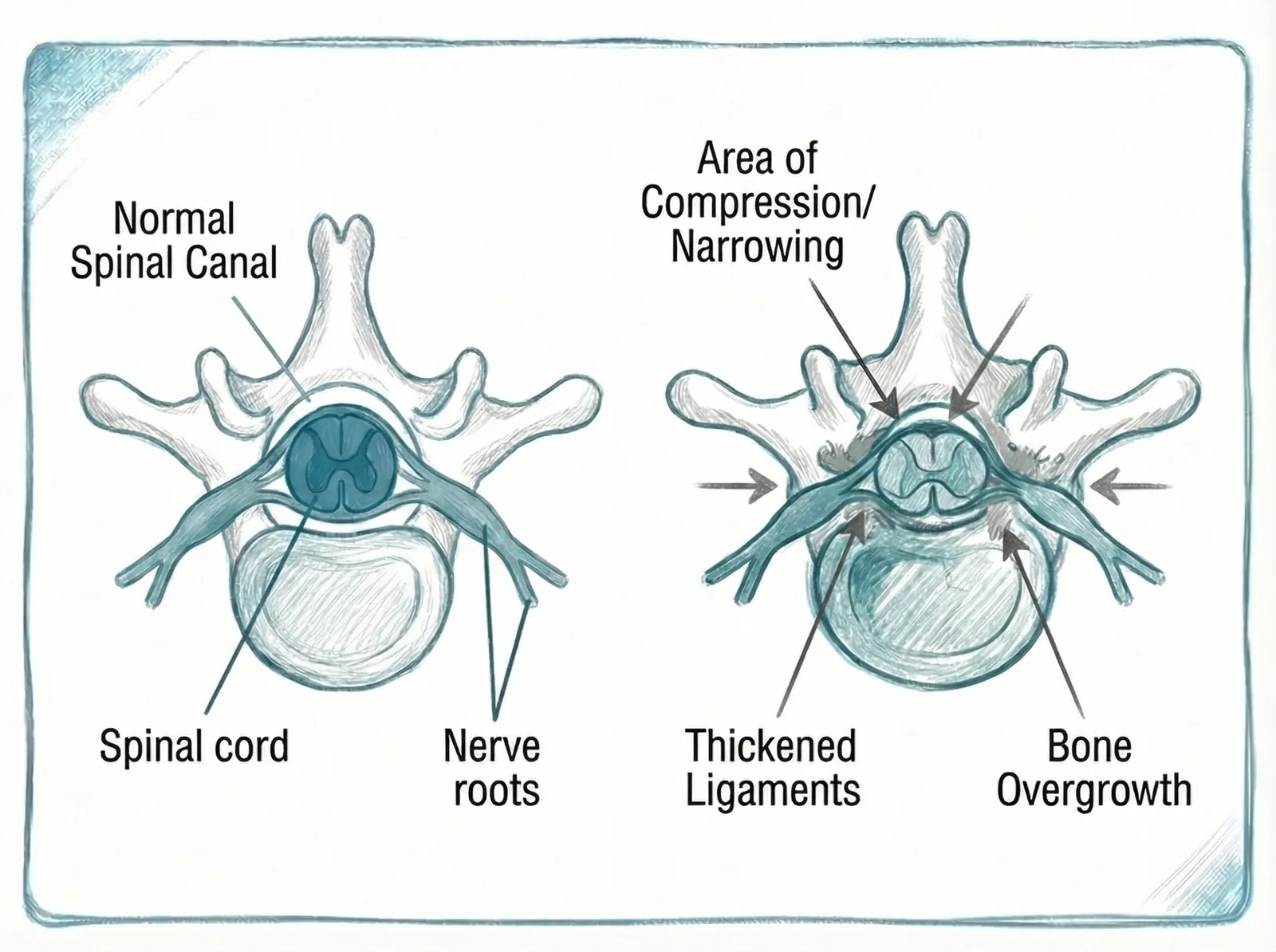
Understanding Your Condition
What Is Spinal Stenosis?
Spinal stenosis is the narrowing of spaces within the spine, which can put pressure on nerves. It most commonly occurs in the lower back (lumbar) and neck (cervical), and symptoms often include pain, numbness, tingling, and in some cases muscle weakness.
The critical question isn't just whether you have stenosis — it's what's causing the narrowing. That distinction determines whether spinal decompression has any relevance to your situation.

Why Type Matters
Not All Stenosis Responds to Decompression
This is the most important thing to understand about stenosis and spinal decompression. The type of narrowing determines whether the therapy has a rational basis.
Foraminal Stenosis with Disc Component
- Narrowing of the nerve exit pathways (foramina) caused or worsened by disc bulging or herniation
- Symptoms that correlate with a disc-related compression pattern
- Cases where disc material contributes to the narrowing rather than bone alone
- Mild to moderate stenosis where conservative care is still appropriate
Central or Severe Bony Stenosis
- —Central canal narrowing caused primarily by bone spurs, thickened ligaments, or facet overgrowth
- —Severe stenosis with progressive neurological symptoms (weakness, balance issues, bowel/bladder changes)
- —Stenosis caused by structural factors that won't change with disc-level intervention
- —Cases where surgical decompression (laminectomy) may be the more appropriate option
Why this distinction is critical
Many clinics market spinal decompression for “stenosis” without distinguishing between types. A patient with foraminal narrowing partially caused by a disc bulge has a very different profile than a patient with severe central canal stenosis from bony overgrowth. Treating them identically ignores the underlying mechanics. A responsible provider evaluates which type you have before recommending anything.
When It Applies
How Decompression May Help Select Cases
For the subset of stenosis patients where a disc component contributes to nerve compression, here's the rationale — and its limits.
Addressing the Disc Component
When a disc bulge or herniation contributes to foraminal narrowing, controlled unloading may alter intradiscal pressure and reduce the disc's contribution to nerve compression. Decompression won't widen a bony canal or reshape thickened ligaments, but it may reduce the total compression on the nerve by addressing the disc component specifically.
Improving Nerve Tolerance
Nerves compressed in narrowed spaces are often in a sensitized state. Reducing even part of that mechanical load may improve nerve tolerance and reduce symptoms — pain, numbness, and tingling — even if the structural narrowing remains unchanged on imaging.
Supporting Functional Capacity
The primary goal for stenosis patients is improved function — walking further, standing longer, sitting more comfortably. When decompression helps, these are typically the changes patients notice first, often before pain scores change.
““Not every patient is a candidate, and saying that openly is what builds trust. The providers I respect most are the ones who turn away patients they can’t help — because it means the patients they do treat get better outcomes.”
Setting Expectations
What Stenosis Patients Should Realistically Expect
Expectations for stenosis are different from expectations for a straightforward disc herniation. Here's what's realistic.
Response Rates Are More Variable
Not all stenosis patients respond to decompression — the response depends heavily on how much of the narrowing involves a disc component versus bony or ligamentous changes. This is why proper evaluation matters more here than for most conditions.
Functional Improvement Is the Primary Goal
For stenosis patients, success is often measured in walking distance, standing tolerance, and daily function — not MRI changes. If you can walk further and stand longer, that's meaningful improvement regardless of what imaging shows.
Structural Narrowing May Persist
Even when symptoms improve, the underlying structural narrowing doesn't necessarily change on imaging. Decompression may alter the environment enough to reduce symptoms without reversing the anatomy. This is consistent with how many conservative therapies work.
Some Patients May Still Need Surgery
For severe or progressive stenosis — especially with neurological deficits — surgical decompression (laminectomy) may ultimately be the more appropriate option. Trying conservative care first is reasonable for many patients, but it's not right for everyone.
When to seek immediate medical attention
If you experience progressive weakness in your legs, difficulty with balance or coordination, or changes in bowel or bladder function, these may indicate severe compression requiring urgent evaluation. These symptoms should be assessed by a medical professional promptly — not managed with conservative care alone.
About Ongoing Management
Stenosis is often a progressive condition, particularly when degenerative changes are involved. Patients who respond to decompression may benefit from periodic maintenance sessions after completing corrective care — not because the treatment failed, but because the underlying condition may continue to evolve.
Maintenance care is always optional, offered separately from corrective care, and recommended only when clinically appropriate.
Candidacy
Are You a Candidate?
Candidacy for stenosis is more nuanced than for most conditions. The type, severity, and cause of narrowing all factor in — and a responsible provider will tell you if decompression doesn't make sense for your specific presentation.
Favorable Indicators
- Foraminal stenosis with a confirmed disc component
- Mild to moderate narrowing without progressive neurological deficits
- Symptoms that correlate with a disc-related compression pattern
- Incomplete relief from PT, injections, or medications
- Seeking conservative options before considering surgery
Contraindications & Limitations
- —Severe central canal stenosis from bony overgrowth
- —Progressive neurological deficits (weakness, balance, bowel/bladder)
- —Stenosis caused entirely by non-disc factors (ligament, bone)
- —Spinal fractures, tumors, infections, or severe instability
- —Prior surgical hardware at the treatment level
- —Severe osteoporosis
Evaluation is especially important for stenosis patients. The difference between a stenosis patient who may benefit from decompression and one who won't often comes down to details visible on imaging and clinical examination. This isn't a condition where you should guess.
Common Questions About Stenosis & Decompression
Honest answers specific to stenosis patients.

Can decompression widen my spinal canal?
No. Decompression does not change bony anatomy. It may reduce the disc's contribution to narrowing in cases where disc material is part of the problem — but it doesn't reshape bone or ligaments.
Read More →
Should I try this before surgery?
For mild to moderate stenosis without progressive neurological symptoms, trying conservative care first is reasonable and consistent with clinical guidelines. For severe or progressive cases, delaying appropriate surgical evaluation isn't advisable.
Read More →
My stenosis is getting worse. Is decompression still an option?
It depends on what's progressing and how severe it is. Progressive neurological symptoms need medical evaluation. Worsening pain without neurological changes may still be appropriate for conservative care. A provider can assess where you are.
Read More →Related Pages


Find a Preferred Provider
Enter your zip code to see if a credentialed provider is available near you.
Why choose a preferred provider?Ready to Find Out If You're a Candidate?
Take our quick 3-minute assessment to see if spinal decompression may be appropriate for your situation. It's free, confidential, and takes just a few questions.
Take the AssessmentGet Started
We've got your info!
We don't have a preferred provider in your area just yet, but we'll reach out as soon as one becomes available.